把A beginner can recognize beaded turquoise jewelry only after separating structure from appearance. A row of round turquoise-colored details might be individual drilled beads, fixed cabochons, molded decoration, or another construction entirely. The word “beaded” should describe how documented parts are organized—not merely what a small product photograph resembles.
This guide uses the Turquoise Western Statement Earrings and the Turquoise Western Stud Earring Set as visual comparison exercises. Their current pages do not clearly identify them as beaded construction. They also do not, through turquoise color or style wording alone, verify natural turquoise, metal, treatment, maker, age, origin, artisan production, or cultural affiliation.
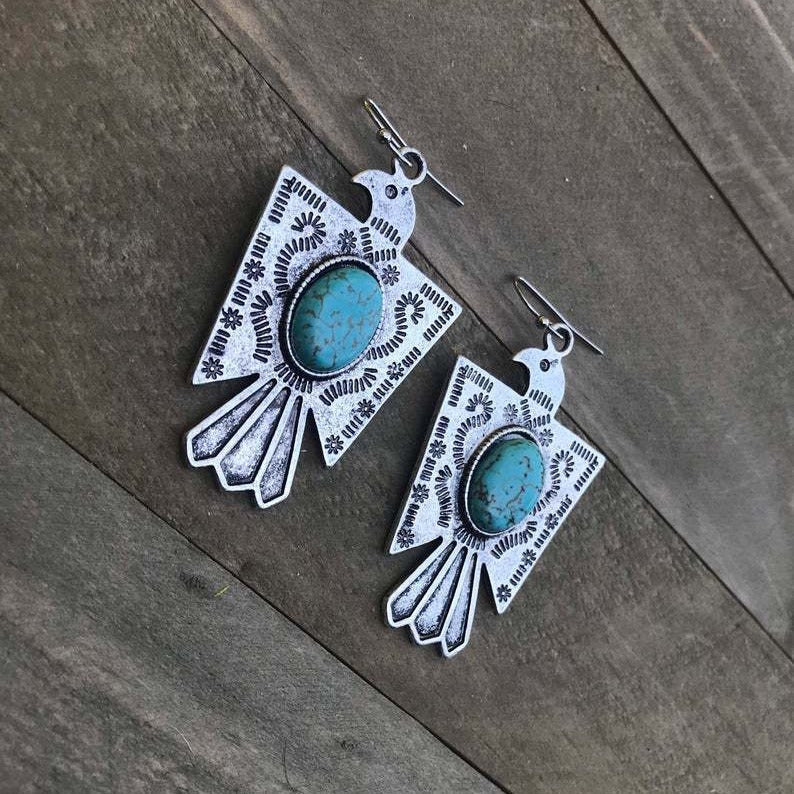
Quick Answer: Learn Four Construction Questions
Ask four questions about every beaded-looking piece:
- What are the separate parts? Identify every bead, stone, imitation, spacer, finding, thread, wire, pin, setting, backing, and decorative body.
- How are the parts connected? Look for stringing, knotting, wire wrapping, linking, pinning, gluing, setting, or molded construction.
- Where can movement occur? Find flexible runs, joints, drops, hooks, and fixed areas.
- Which instructions govern the weakest part? Mixed construction often needs a conservative care plan.
If the seller cannot document these points, call the feature turquoise-colored or bead-like only when that visual wording is accurate. Do not promote an assumption into a product fact.
The public introduction to Western jewelry styles, symbols, materials, and wear explains the wider distinction between aesthetic labels and verified construction.
Beginner Vocabulary: What the Terms Actually Do
A bead is a separate component commonly designed to be strung, linked, sewn, wired, or otherwise incorporated into jewelry. Its material, hole, treatment, shape, and construction still need documentation. A round or oval detail is not automatically a bead.
A cabochon is a shaped, generally unfaceted decorative piece intended for a setting or attachment. Its appearance does not identify its material. A stud describes an earring style that sits close to the ear; it does not describe the decorative material. A drop or dangle describes hanging movement. A spacer separates components within a sequence.
Turquoise-style or turquoise-colored can accurately describe appearance when material identity is unresolved. Natural turquoise, treatment, mine source, region, age, maker, and cultural affiliation require stronger evidence.
Build a Beginner's Observation Grid
Open a product image at a useful size and divide observations into three columns: visible, stated, and unknown. “Five round blue-green details are visible” belongs in visible. “The seller states they are individual beads” belongs in stated. “Material and attachment are unknown” belongs in unknown.
| Feature | Safe observation | Question before buying |
|---|---|---|
| Round colored detail | Turquoise-colored round form | Is it a separate drilled bead, a set element, or molded decoration? |
| Repeated sequence | Several similar forms are visible | How are they connected, spaced, and secured? |
| Metal-colored spacer | Silver-colored or gold-colored appearance | What is the base component and finish? |
| Flexible-looking run | The photograph suggests movement | What thread, wire, link, or cord creates it? |
| Western motif | A recognizable shape is visible | What does it mean to the wearer, and is provenance documented? |
The grid prevents a common beginner error: believing that more descriptive confidence produces more factual accuracy.
Explore Cowgirl Style by Jewelry Zone
Use the Cowgirl Jewelry collection as a visual index. Sort products into ears, neckline, wrist, hand, waist, and other accessory zones. Choose one zone for the first outfit.
Cowgirl style can be a broad merchandising or wardrobe direction. It does not require boots, hat, fringe, large buckle, turquoise color, and multiple motifs in every look. Begin with a familiar outfit and one documented accessory.
The cowgirl jewelry guide to earrings and necklaces helps assign different roles to the face and neckline instead of filling every zone at once.
Choose a Beginner Uniform
Select an outfit already worn comfortably: white shirt and jeans, plain tee and denim, black dress, knit and trousers, or another real uniform. Photograph it without jewelry. Mark collars, hair, glasses, hats, headsets, phone position, bag straps, jacket edges, and workplace equipment.
For an earring, the operating zone runs from piercing to collar and jaw. For a necklace, it runs through neckline, placket, pocket, belt, bag, and seat belt. For a bracelet, it includes desk, cuffs, sink, and tools. The product must fit the zone, not an idealized photograph.
Name the intended jewelry job in one sentence: “face-level color for an open neckline,” “a modular stud choice for a quiet work outfit,” or “a documented bead sequence for a single focal necklace.”
Example One: Turquoise Western Statement Earrings
The current product page displayed $29.99 USD and one visible color selection during review. It describes a sculptural Western statement silhouette with turquoise-style center stones and vintage-inspired detailing, and suggests denim, boots, dresses, and occasion or cowgirl looks.
The visible page did not clearly call the construction beaded or state exact dimensions, weight per earring, fastening, backing, complete components, finish, attachment method, or option-specific care. “Boho texture” is a styling description, not proof that separate beads are present.
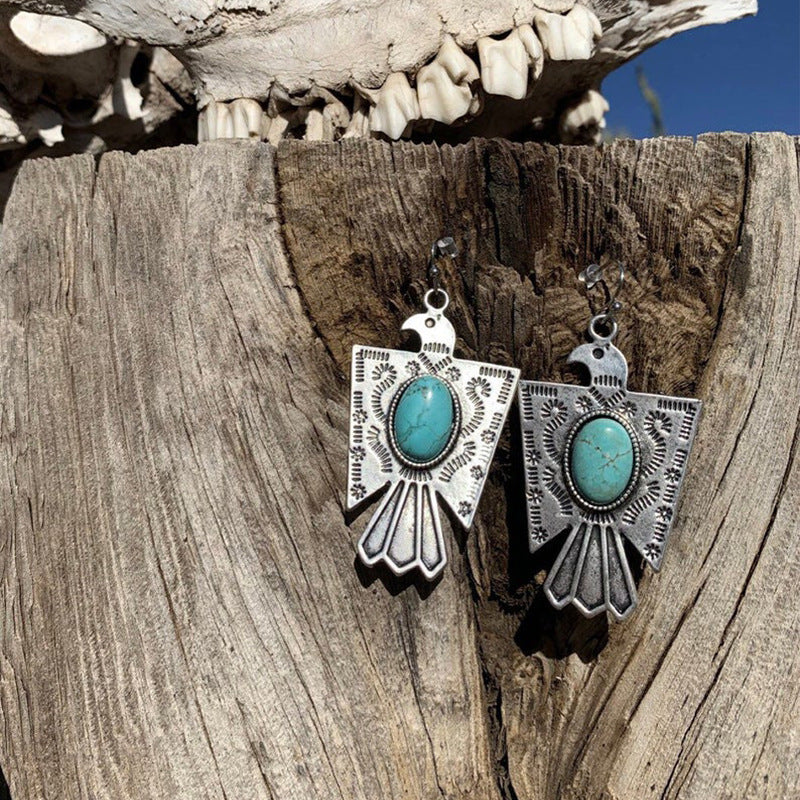
What a Beginner Can Say
The earrings show a turquoise-style statement direction and a sculptural face-level silhouette. Product imagery can help identify visible shapes and compare likely visual intensity.
What a Beginner Should Ask
- Are any visible forms separate beads? If so, what are they and how are they attached?
- What are the complete height, width, profile, and weight per earring?
- What post, hook, backing, or closure is included?
- What are all components, finishes, connections, and care instructions?
First Outfit
Use a plain shirt, jeans, no necklace, and quiet shoes. Clear hair, collar, glasses, phone, and hat from the verified earring envelope. A statement pair should not need several other face-level signals to communicate its role.
Example Two: Turquoise Western Stud Earring Set
The current page displayed $29.99 USD and one visible color selection during review. It describes a coordinated turquoise-style assortment with floral, geometric, and classic stud shapes for everyday styling and gifting.
The visible page did not clearly state the exact number of wearable pairs, image-to-inclusion mapping, individual dimensions, weight per stud, post and backing types, complete components, finishes, construction, or care. It also did not clearly identify a beaded construction.
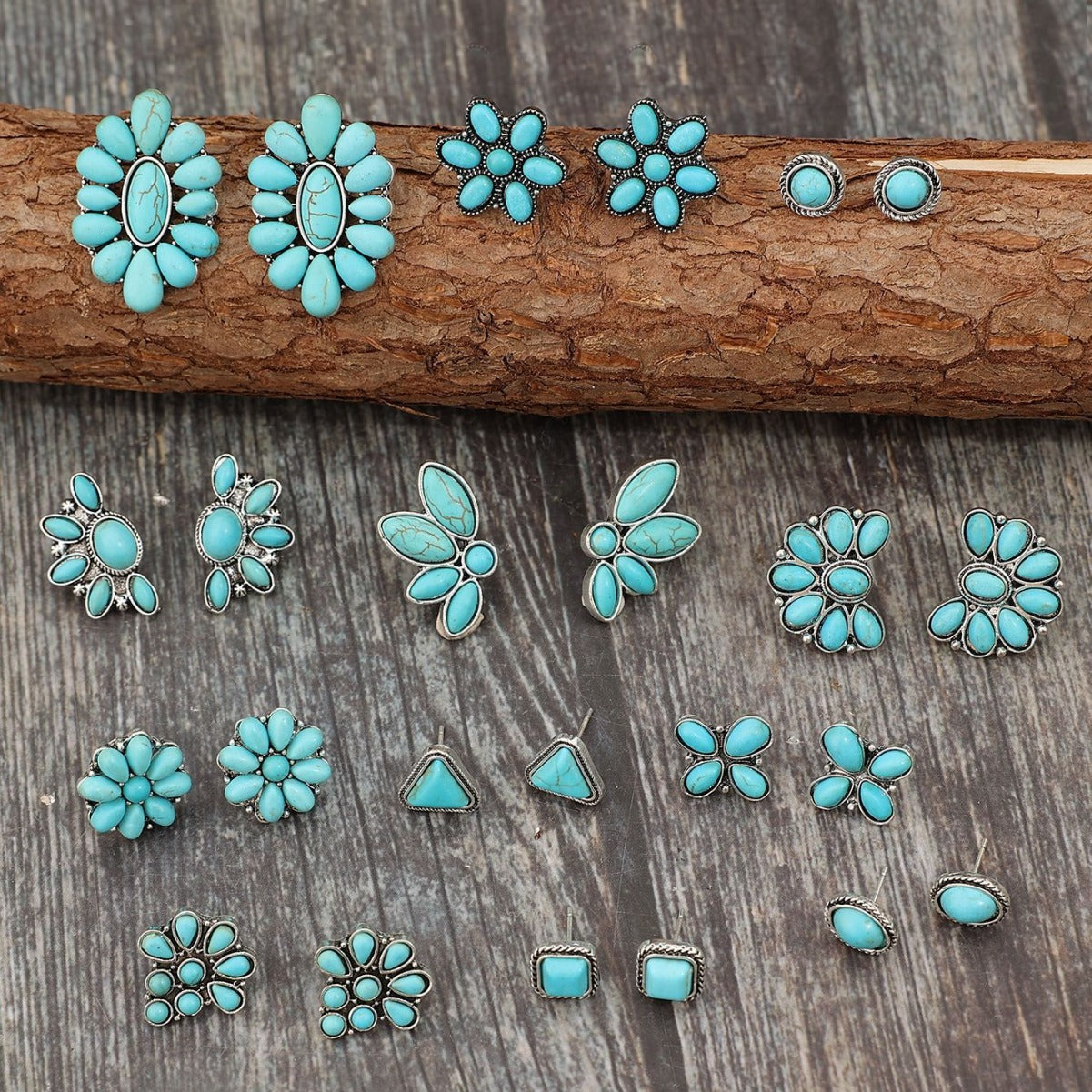
What a Beginner Can Say
The visible assortment offers several face-level shapes within a turquoise-style Western direction. A confirmed set may allow the wearer to test a quieter form before a stronger motif.
What a Beginner Should Ask
- How many complete pairs are included, and which image shows them?
- Which pieces are intended for which piercing placements?
- What are each pair's dimensions, weight, post, and backing?
- Are any parts separate beads, and what are all components and attachments?
- Do care instructions differ between shapes?
First Outfit
Choose one seller-confirmed pair, an empty neckline, a familiar shirt, and jeans. Do not wear every visible shape at once or assume a styled photograph is a placement map for the wearer's piercings.
Compare Statement and Stud Directions
| Beginner decision | Statement earrings | Stud set |
|---|---|---|
| Visual job | One stronger face-level silhouette | Modular quieter-to-stronger rotation |
| First evidence question | Scale, weight, movement, fastening | Exact contents, pair mapping, posts, backings |
| Beaded status | Not established by the visible page; request construction details | |
| First outfit | Quiet neckline and hair clearance | One confirmed pair and no competing set |
| Primary risk | Collar, hair, phone, or headset contact | Assuming every visible piece is included or suitable |
The products solve different wardrobe jobs. They should not be compared only by price or turquoise color.
Build a Genuine Beaded-Jewelry Checklist
When a product is explicitly documented as beaded, add fields beyond ordinary style:
- bead count or sequence where relevant;
- bead material, treatment, shape, size, hole, and finish;
- stringing medium, wire, thread, chain, or links;
- knots, crimps, pins, loops, spacers, caps, and closures;
- flex points, abrasion zones, exposed ends, and repair path;
- option-specific moisture, cosmetics, cleaning, drying, and storage guidance.
The weakest documented component should influence handling. A cleaner compatible with one bead may be unsuitable for its finish, thread, adhesive, spacer, or adjacent unknown part.
Use a Seven-Day Beginner Lab
- Day 1: study one product image and fill visible, stated, and unknown columns.
- Day 2: request missing construction and fit facts.
- Day 3: map the face or body operating zone.
- Day 4: make a life-size paper outline from confirmed measurements.
- Day 5: build one outfit from owned clothes.
- Day 6: rehearse movement and storage.
- Day 7: compare evidence quality and decide whether to buy, wait, or reject.
This is an observation exercise. Do not attach mock-ups to skin or piercings, and do not perform destructive product tests.
Video Lesson: A Short Introduction Needs Independent Checks
The supplemental source is A Beginners Guide To Turquoise Jewelry by LaCkore Couture. The current page presents broad historical and cultural language about turquoise. It does not document either Oroxen earring listing.
Use the video as an introductory prompt, not as evidence of these products' material identity, construction, treatment, maker, origin, age, or cultural affiliation. Broad historical claims should be checked against authoritative sources before reuse.
No product-specific proof follows from sharing a turquoise-colored appearance. A responsible beginner preserves the boundary between learning about a category and verifying an item.
Beginner Mistakes and Repairs
- Mistake: calling every round detail a bead. Repair: ask how separate parts are constructed.
- Mistake: calling turquoise color natural turquoise. Repair: request option-specific disclosure.
- Mistake: wearing a whole visible assortment. Repair: confirm contents and choose one appropriate pair.
- Mistake: buying a complete cowgirl costume. Repair: begin with one familiar outfit and one zone.
- Mistake: ignoring weight and fastening. Repair: request numbers and hardware details.
- Mistake: transferring video claims to a product. Repair: separate category context from listing evidence.
- Mistake: using cultural labels from appearance. Repair: require reliable provenance and appropriate context.
The public complete Western turquoise-style guide provides a deeper evidence-first next step.
Care and Storage for an Unverified Piece
Do not submerge, polish, steam, ultrasonically clean, heat, or apply household products to an item with unknown components or construction. Ask for option-specific care. Photograph condition before any action.
Store each piece separately in a clean protected compartment compatible with the confirmed materials. Keep earrings with their correct backings and do not allow decorative surfaces to rub against other jewelry. Stop wearing a loose, bent, cracked, peeling, or insecure piece and seek suitable advice.
If a genuine strung-bead item later enters the wardrobe, inspect thread, wire, knots, crimps, closures, and movement zones without pulling or flexing. Schedule inspection rather than automatic cleaning.
Frequently Asked Questions
Are these two example products definitely beaded?
The current visible pages do not clearly establish beaded construction. Ask for exact component and attachment information before using that label.
Can cowgirl-style beginners wear statement earrings?
Yes, when verified size, weight, fastening, components, symbolism, collar, hair, equipment, and activity suit the wearer.
Does a stud assortment include every item shown?
Do not assume so. Request an exact inclusion list, pair mapping, and image confirmation.
Is turquoise-style jewelry restricted by gender?
No. Choose for the individual wearer, context, fit, preferences, symbolism, and documented facts rather than a merchandising label.
Can beaded jewelry be cleaned with water?
Not by default. Components, treatments, stringing, finishes, adhesives, and closures may respond differently. Follow exact product guidance.
How should a beginner avoid costume-like styling?
Use one familiar outfit, one jewelry zone, and one leading color, motif, or texture. Add a second element only after the first formula succeeds.
Final Beginner Checklist
- Separate visible, stated, and unknown facts.
- Use beaded only when construction supports it.
- Confirm product option, contents, dimensions, weight, fastening, components, construction, and care.
- Choose one familiar outfit and one jewelry zone.
- Make a life-size outline and map real contact.
- Keep material, origin, and cultural claims evidence-based.
- Store and care for the weakest confirmed component.
Explore current styles in Western Jewelry or return to Oroxen for live product and store information. A cowgirl-style beginner does not need to know every jewelry term immediately. The useful skill is knowing what can be observed, what has been stated, and what still requires proof.