One turquoise-colored ring can change a white-shirt-and-jeans outfit seven different ways without requiring seven new wardrobes. The variation comes from hand placement, sleeve shape, shirt styling, denim wash, supporting accessories, and the activity for which the outfit is built. The ring should have one clear job in each version.
This guide uses two current Oroxen examples: the Turquoise Vintage Heart Cross Ring for Women and the Turquoise Vintage Ring for Women. Their titles describe a turquoise-colored, vintage-inspired visual direction. They do not by themselves establish natural turquoise, specific metals, age, treatment, origin, maker, artisan production, or cultural affiliation.
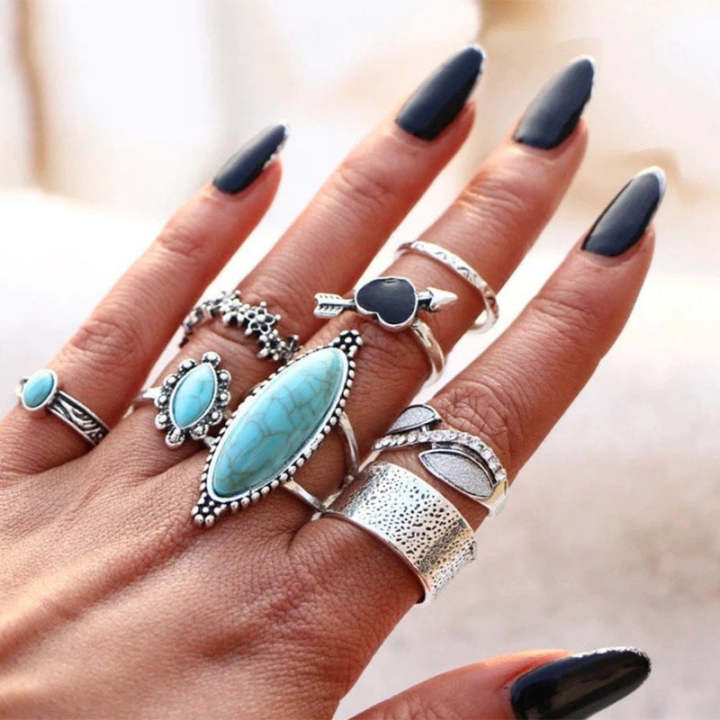
Quick Answer: Change One Variable per Look
Start with the same white shirt, jeans, shoes, and one verified ring. For each new formula, change only one principal variable: cuff, tuck, denim wash, jacket, supporting jewelry zone, shoe formality, or occasion. Photograph the complete result from face, waist, and hand level.
This controlled method reveals why an outfit works. If every garment and accessory changes at once, the ring becomes decoration inside a collage rather than a useful part of a repeatable wardrobe. A good first formula should survive ordinary movement, hand washing, phone use, a bag, and an outer layer.
Before styling, use the public seven ways to wear turquoise rings with a black dress as a contrast exercise. A black dress offers one continuous field; a white shirt and jeans divide the body into light fabric, blue denim, buttons, cuffs, pockets, and a visible waist. The ring needs different spacing.
Prepare the Base Outfit
Choose one white shirt that already fits and one pair of jeans suited to the real activity. Steam or press the shirt if that is normal for the fabric, clean the jeans, and remove unrelated accessories. Photograph the base in daylight and indoor light.
Record the shirt's cuff depth, sleeve volume, buttons, placket, pockets, yoke, hem, and collar. Record the jeans' wash, rise, leg shape, distressing, contrast stitching, and hardware. These details create the visual environment around the hand whenever it rests near a pocket, belt loop, tabletop, or bag.
Next, map the hand. Note the intended finger, neighboring rings, dominant hand, knuckle shape, working tasks, phone grip, keyboard position, steering or transit habits, gloves, and swelling across the day. Styling cannot rescue a ring that pinches, rotates constantly, catches fabric, or enters an unsafe work zone.
Make a Ring Evidence Card Before Wearing It
A reliable styling plan begins with facts. Create one evidence card for each candidate and record:
- exact product name, URL, option, and dated price;
- available numerical sizes and the sizing system used;
- interior diameter or circumference for the selected size;
- face height, face width, band width, profile, and total weight;
- all components, finish, setting, construction, and stone or imitation disclosure;
- care guidance, current availability, shipping timing, and return conditions;
- the photograph that maps to the exact selected option.
Write “not visibly stated” in an empty field. Never convert a turquoise color into natural-stone identity or a vintage-inspired appearance into age. The broader Western turquoise jewelry buying guide explains this evidence boundary in more detail.
Compare the Two Current Ring Examples
The Turquoise Vintage Heart Cross Ring for Women displayed $88.88 USD during review and one visible color selection, but no clearly labeled numerical size choices in the visible selector. Its name and page copy emphasize turquoise, vintage, heart, and cross styling. The visible summary did not clearly supply exact ring size, dimensions, weight, components, finish, setting, construction, or option-specific care.
The Turquoise Vintage Ring for Women displayed $66.66 USD during review with sizes US 6 through US 11. A US label is useful only when its exact interior measurement, the seller's sizing convention, and the intended finger are confirmed. The visible summary did not clearly state face dimensions, band width, profile, weight, components, finish, setting, construction, or option-specific care.
| Field | Heart cross ring | Vintage ring |
|---|---|---|
| Visible styling signal | Heart and cross motifs | Turquoise-colored vintage-inspired direction |
| Visible option cue | One color selection; numerical size not clearly shown | US 6–11 shown during review |
| Immediate question | What exact size and measurements are available? | What interior measurement maps to each US size? |
| Shared unknowns to resolve | Face scale, band, profile, weight, complete components, finish, setting, construction, and care | |
Prices and availability can change. Check the live page before ordering. More important, compare the two rings on equivalent fields; do not allow a visible size selector on one page to stand in for the complete fit record.
Way One: Crisp Cuff, Single-Hand Focus
Button the white shirt cuff and keep the sleeve at full length. Wear one ring on the hand that appears naturally when holding a bag, phone, or coffee cup. Use dark straight jeans and simple shoes. Remove bracelets and competing rings for the first trial.
This formula creates a small reveal: the ring appears beyond a clean white edge. It works best when the cuff does not strike the ring face, the buttons stay clear, and the ring does not catch while the sleeve moves. A tall or wide face may require more clearance than a compact one.
Perform ten ordinary movements: button and unbutton the cuff, reach into a pocket, type, use the phone, zip a bag, put on a coat, fasten a seat belt, turn a doorknob, carry a mug, and wash hands according to documented care. Stop if the ring rotates, pinches, snags, or hits hardware.
Way Two: Rolled Sleeves and an Open Wrist
Roll each sleeve once or twice in the same way, exposing more forearm while leaving the ring as the only jewelry on that arm. Pair with mid-wash relaxed jeans and understated footwear. The open wrist creates distance between the shirt edge and ring, which can make a decorative face feel more deliberate.
Do not add a cuff bracelet automatically. First view the outfit at full-body scale. If the ring already supplies enough color and surface detail, an empty wrist becomes useful negative space. If a bracelet is later added, confirm that it cannot slide into the ring during movement.
The roll must stay secure during activity. Loose fabric traveling down the forearm can catch a raised ring. A sleeve that requires constant adjustment is a styling failure even when the still photograph looks polished.
Way Three: Half-Tuck with a Pocket-Side Ring
Half-tuck the shirt on one side and place the ring on the hand that naturally rests near the opposite front pocket. Use jeans with modest hardware and no dramatic belt buckle. This creates a diagonal relationship between the asymmetrical shirt hem and the colored hand-level accent.
The formula should look intentional without posing. Walk, sit, and stand; let both hands rest naturally. If the ring is visible only when the hand is staged on the hip, it may not be the everyday focal point the shopper expects.
Check rivets, zipper pulls, keys, and pocket openings. Hard metal-to-ring contact can affect comfort and surfaces. Keep the ring away from tasks that expose it to impact, abrasion, chemicals, or pressure, and follow option-specific care rather than a generic online cleaning recipe.
Way Four: Heart Cross Motif as the Only Symbol
Use the heart cross ring as the single recognizable motif. Choose a plain white shirt without embroidery, a clean pair of jeans, simple leather-looking or fabric shoes, and an unadorned bag. “Leather-looking” describes appearance only unless the product is documented as leather.
A heart and cross may carry personal or religious meaning. Confirm that the wearer wants both shapes, the setting permits them, and the gift recipient has not been assigned symbolism without consent. Do not call the ring sacred, antique, Native American, Indigenous, tribal, regional, or artisan-made without reliable evidence.
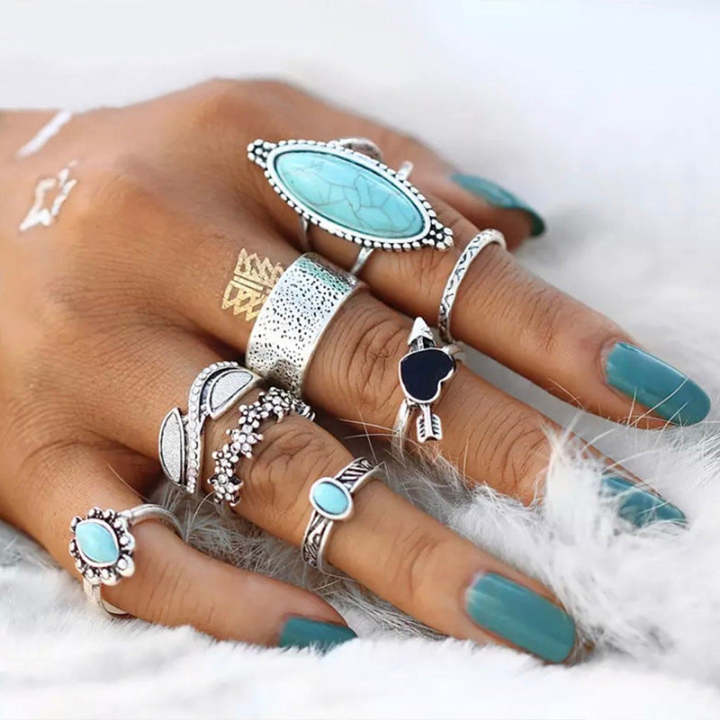
If the ring face is bold at life size, let the motif lead and omit a turquoise-colored necklace or Western buckle. If it proves compact, the outfit may accept one quiet supporting texture—but test the ring alone first.
Way Five: Vintage-Inspired Ring with a Denim Layer
Wear the second ring with a white shirt, jeans, and a denim jacket in a wash that differs enough from the jeans to look intentional. Keep the shirt visible at the collar and cuff. The outfit now has two denim fields, so the ring should remain the only turquoise-colored element during the first test.
This formula adds hardware: jacket buttons, snaps, zipper, or pocket rivets. Put the jacket on and remove it several times while observing the ring hand. Use the opposite hand for hardware when practical, but do not build an outfit that requires unnatural movement all day.
The public turquoise jewelry and denim jacket guide offers a full contact-map method for layered outfits. Apply its logic to the ring rather than assuming hand jewelry never interacts with outerwear.
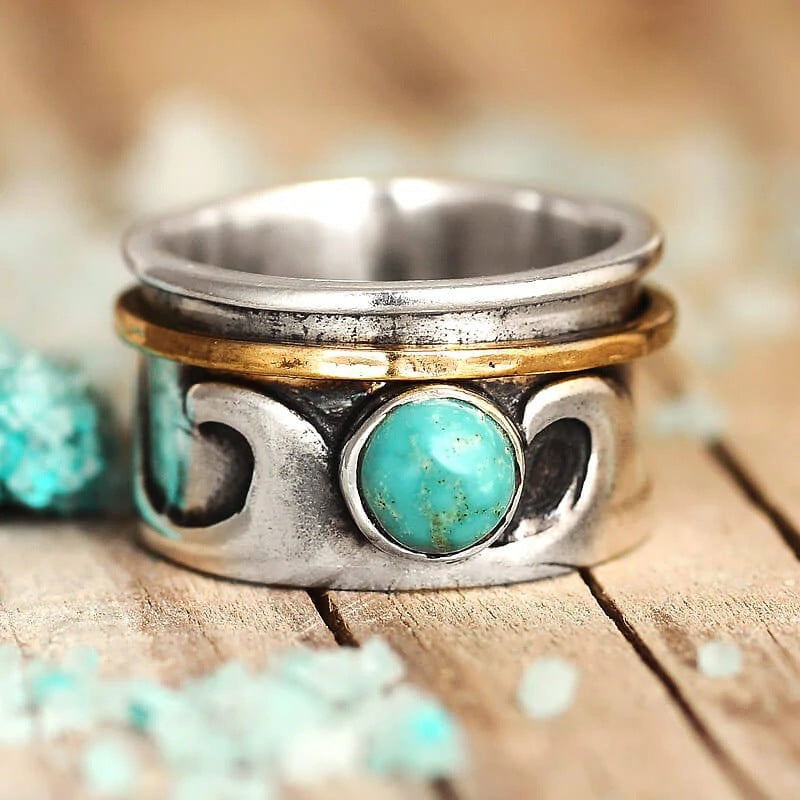
Way Six: Quiet Workday Version
Choose the lowest-profile verified ring and a finger that does not interfere with the day's equipment. Wear a tucked white shirt, dark clean jeans only if workplace rules allow, and closed simple shoes. Remove bracelets, long necklaces, large belt hardware, and extra motifs.
Work suitability is not determined by the word “everyday” in a product description. Consider machinery, gloves, tools, food preparation, clinical hygiene, chemicals, lifting, childcare, security checks, sports, and employer policy. In some environments, removing the ring is the only appropriate option.
Plan safe storage before removal. Use a designated pouch or container consistent with documented care, not a loose pocket, sink edge, shared tray, or bag bottom. A practical outfit includes the moment when the jewelry cannot be worn.
Way Seven: Evening Upgrade Without Changing the Base
Keep the same white shirt and jeans, change to a cleaner shoe and bag, adjust the shirt tuck, and let the ring remain the primary colored accent. If adding earrings, use small, verified, visually quiet ones. Avoid introducing a necklace, cuff, statement belt, and multiple rings simultaneously.
Photograph the daytime and evening versions side by side. The upgrade should come from finish and proportion rather than costume accumulation. If the ring disappears at conversational distance, improve sleeve position or hand-level contrast before buying another accessory.
The method works across seasons by changing the layer, not the core logic. A light jacket, structured coat, or knit changes contact and visibility. Re-run the movement check every time the layer changes.
How to Decide Which Ring Fits Which Formula
Assign each ring four scores from zero to three: fit evidence, clearance, symbol alignment, and wardrobe reach. A zero means unresolved, not bad. A ring with a beautiful image but missing size earns zero for fit evidence until the seller supplies a usable measurement.
The heart cross option may lead formulas where intentional symbolism is welcome and the confirmed face scale remains clear of cuffs and equipment. The second vintage-inspired ring may lead formulas where a numerical size can be matched to a measured finger and where its confirmed profile suits the activity. These are conditional directions, not product guarantees.
Use the Western Rings collection to compare other silhouettes only after the desired job is defined. A collection is a discovery tool; every candidate needs its own evidence card.
Video Note: Separate Styling Inspiration from Product Proof
The supplemental video is Wear It With Style: Turquoise Jewelry by JTV. At review, YouTube showed a 43-second video with no closed captions. Its visible description presents turquoise as versatile enough for bold or subtle styling.
The bold-versus-subtle idea is useful: Ways Four and Seven can give the ring a more visible role, while Ways One and Six keep it restrained. The video does not document either Oroxen listing and cannot verify their materials, size, fit, origin, treatment, construction, care, or cultural context.
Because no transcript was available, this article does not quote or reconstruct the spoken content. Use the video as a visual prompt, inspect the original source directly, and base purchase claims on the live product record.
Common Styling Mistakes and Better Alternatives
- Buying the ring before measuring the finger. Measure at relevant times and confirm the seller's exact size mapping.
- Wearing a wide face against a tight cuff. Open the wrist or choose a verified lower profile.
- Matching every blue-green item. Let one turquoise-colored accent lead.
- Stacking before testing one ring. Establish rotation, pressure, clearance, and care first.
- Assuming vintage means old. Use vintage-inspired unless age is documented.
- Ignoring symbols. Confirm meaning, consent, and setting.
- Cleaning from a generic internet recipe. Obtain option-specific component and care instructions.
- Keeping the outfit static. Test pockets, bags, jackets, work, transit, and hand washing.
For a different garment test, the published turquoise ring and black dress checklist shows how a single-color outfit changes the spacing problem.
Create a Seven-Look Photo Ledger
Make one page for each formula. Include the date, exact garments, ring and option, intended finger, sleeve position, other jewelry, shoes, bag, outer layer, activity, light, and three photographs. Add five scores: initial fit, end-of-wear fit, rotation, contact, and desire to repeat.
Keep purchase evidence and personal wear notes separate. Product facts belong in the evidence card; swelling, comfort, styling preference, and routine belong in the private ledger. Never generalize one person's fit experience into a universal sizing claim.
After seven trials, circle the two formulas that require the least adjustment. Those are stronger than the most dramatic photograph because they are more likely to be worn again. Repeat each winner three times before buying supporting jewelry.
Frequently Asked Questions
Can a beginner wear a large turquoise-style ring?
Yes, when exact fit, face dimensions, profile, weight, movement, care, and activity are compatible. Begin with one ring and open space around it.
Which finger is best?
There is no universal finger. Measure the intended finger, consider dominant-hand tasks and neighboring fingers, and use the seller's confirmed sizing system.
Should a ring match a turquoise necklace?
Matching is optional. First determine which zone leads. If both are worn, verify components and care separately and maintain enough visual space for each.
Can turquoise-colored rings be worn year-round?
Color can work across seasons, but gloves, sleeves, coats, heat-related swelling, work, and care change. Repeat fit and contact checks when conditions change.
How do I know whether the product contains natural turquoise?
Do not decide from the title, color, photograph, price, or an unrelated video. Request option-specific material disclosure and appropriate documentation if identity affects the decision.
What should I do when a ring size is not listed?
Ask the seller for available sizes, sizing convention, and interior measurement. Do not order based only on an image or a different ring that happens to fit.
Final Seven-Way Checklist
- Choose one real white shirt and one real pair of jeans.
- Build a complete, option-specific ring evidence card.
- Confirm fit, face dimensions, profile, weight, components, construction, and care.
- Test one formula at a time and change one principal variable.
- Keep symbolism intentional and cultural or origin claims evidence-based.
- Map cuffs, pockets, jacket hardware, tools, phone, bag, and hand-washing routine.
- Photograph all seven looks and repeat the two easiest winners.
Explore more current options in Western Jewelry or return to Oroxen for live store and product information. Seven successful looks do not come from seven purchases. They come from one documented ring, one familiar base outfit, and seven controlled changes that respect fit, function, meaning, and evidence.