A white shirt and jeans can either frame boho turquoise jewelry or compete with it. The difference is rarely the price of the clothes. It is the way attention is distributed across the collar, sleeves, waist, shoes, bag, hair, and jewelry. When every area asks to be noticed, no focal point survives. When the outfit gives one piece a clear visual lane, even a familiar combination feels deliberate.
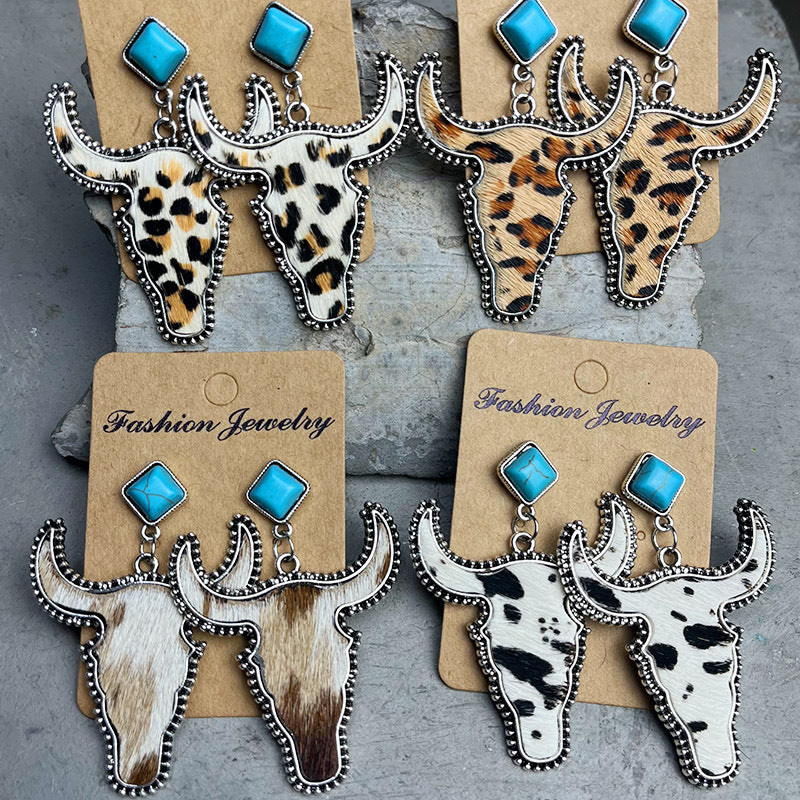
This guide builds that lane with two current examples: the Western Turquoise Boho Vintage Cow Skull Earrings and the Turquoise Boho Vintage Geometric Floral Jewelry Set. Product names describe an aesthetic; they are not certificates of gemstone identity, metal composition, age, production method, origin, or cultural affiliation. Confirm the exact option and its documented specifications before buying, wearing, cleaning, or gifting it.
Quick Answer: Give the Outfit an Attention Budget
Imagine the outfit has ten attention points. Spend six or seven on one jewelry zone, two on garment shape, and the remainder on shoes or a bag. Do not spend ten points in four places at once. This simple budget prevents the white shirt, denim details, earrings, necklace, belt, and boots from becoming equal competitors.
- Name the leader. Choose ears, neckline, wrist, or hand before dressing.
- Clear the neighborhood. Reduce patterns, hardware, and overlapping lines near that area.
- Repeat only one quiet cue. Echo a color, shape, or finish once rather than matching everything.
- Check from conversation distance. The focal point should remain readable from several feet away.
- Test real movement. Sit, turn, use a bag, add outerwear, and remove it again.
The result should look edited, not empty. A crisp shirt and well-chosen denim already supply enough structure for expressive jewelry.
Build a Focal-Point Ladder Before Choosing Accessories
A focal-point ladder ranks every visible element from first noticed to barely noticed. Write the list before adding jewelry. A sample order might be earrings, face, shirt collar, denim silhouette, shoes, and bag. If a logo belt, distressed knee, printed scarf, bright lip color, and ornate boot all sit above the intended jewelry, the ladder is too crowded.
Use a phone photograph in neutral light. Blur your eyes or view the image as a small thumbnail. Whatever remains obvious at that size is consuming attention. Remove or quiet one competitor, photograph again, and stop when the chosen jewelry zone wins without making the rest of the outfit feel unfinished.
This is different from matching. Matching asks whether colors resemble each other. Hierarchy asks what the viewer sees first, second, and third. An exact color match can still look busy, while a controlled contrast can create a clean lead.
Choose the White Shirt as Negative Space
The white shirt is not a blank object; it has sheen, texture, seams, buttons, pockets, cuffs, and a collar. Each detail changes how much calm space surrounds the jewelry. A plain matte fabric usually creates a quieter field than a shirt with embroidery, oversized chest pockets, pearl-like buttons, ruffles, or high-contrast stitching.
For an earring-led formula
Open the collar only as far as comfort and dress rules allow. Keep hair placement consistent during the test because hair can hide an earring, frame it, or tangle with it. If the earring has a strong silhouette, let the collar remain simple and avoid another large motif at the neckline. Roll sleeves only if the cuff does not become a second statement.
For a necklace-led formula
Choose a neckline corridor before choosing additional accessories. The necklace should sit against an uncluttered portion of fabric or skin and should not repeatedly strike buttons, zipper teeth, collar points, or bag hardware. Do not alter chain length unless that position is supported by the selected product's documented adjustment range.
The public guide to styling turquoise jewelry with denim layers provides a separate method for planning the collar and jacket transition.
Use Jeans to Control the Lower Half of the Frame
Denim supplies color variation, texture, seams, pockets, rivets, fading, distressing, and a strong silhouette. Those features can support the jewelry or pull attention downward. If the focal point is near the face, cleaner denim and restrained hardware make the visual climb easier. When jeans are heavily distressed or decorated, keep the shirt and accessories especially disciplined.
Fit matters more than a universal rule about skinny, straight, wide, or boot-cut jeans. Check where the hem lands, how the waistband behaves when seated, and whether the silhouette fits the destination. A visually quiet pair that feels uncomfortable will not remain quiet once the wearer repeatedly adjusts it.
Use shoe color to finish the lower frame rather than to start another story. A boot can support Western-inspired styling without repeating every motif. If boots have strong embroidery, studs, or contrast panels, lower the jewelry's supporting accessories accordingly.
Formula One: Let Cow-Skull Earrings Lead
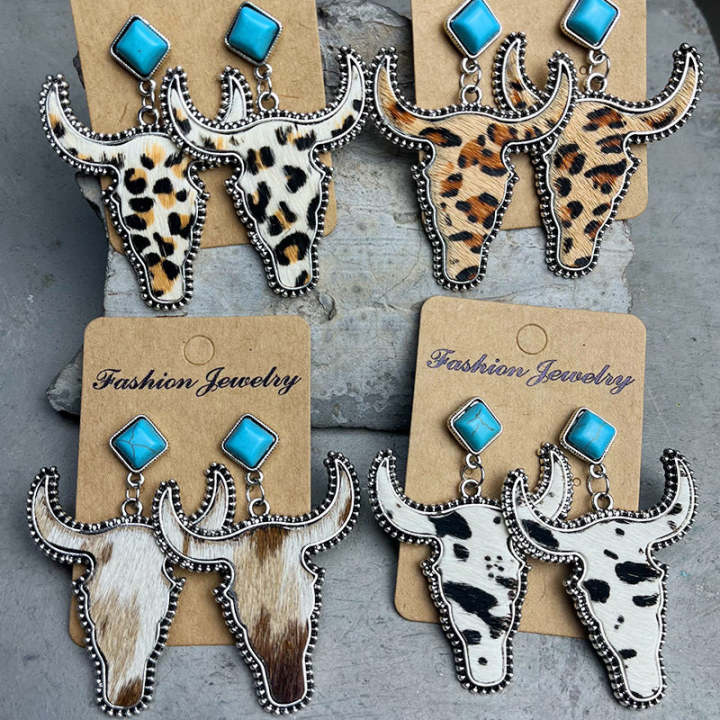
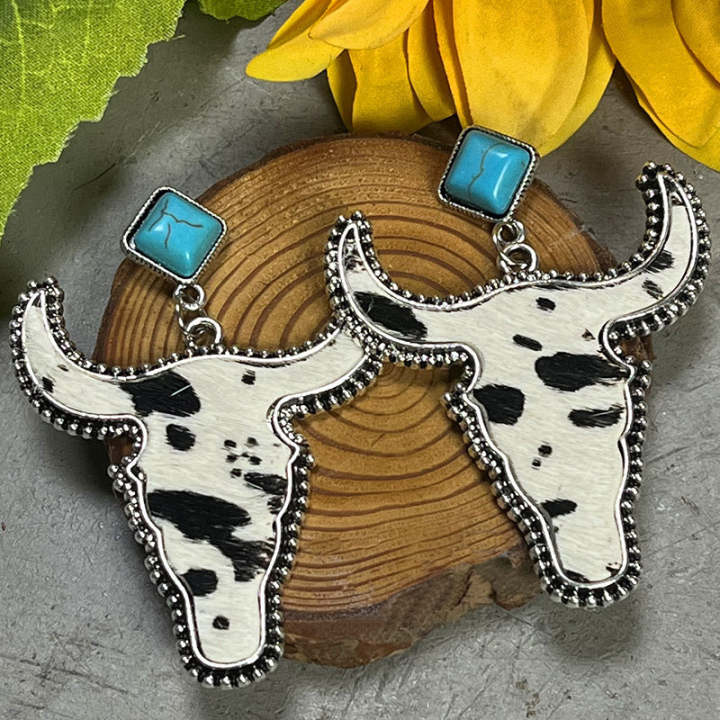
During review, the cow-skull earring page showed a price of $141.40 USD and four selections named Design 1, Design 2, Design 3, and Design 4. The visible description emphasized Western, turquoise, and boho styling and reminded shoppers to inspect the chosen option and images because screen color can differ.
The summary did not plainly map every design label to a written description, and it did not give numerical measurements, per-earring weight, closure type, backing, a complete component list, finish construction, or care directions for each option. Those omissions matter. A photograph can suggest scale, but it cannot establish weight or comfort. Ask for the missing option-specific details when they affect your decision.
Build the outfit from the ears downward. Start with a smooth white shirt, jeans with limited surface decoration, and shoes that do not introduce another large animal or cross motif. Then decide whether the hair should sit behind the ears, on one side, or away from both earrings. The correct choice is the one that avoids snagging and keeps the selected design readable.
Skip a large necklace on the first trial. If the outfit feels unfinished, add a plain, verified small-scale piece only after the earrings have passed a movement test. Turn the head fully, use a phone, put on glasses or sunglasses, lift a shoulder bag, and add outerwear. Stop if the earring catches, strikes the neck, or interferes with equipment.
Formula Two: Turn a Three-Piece Set into a One-Leader System
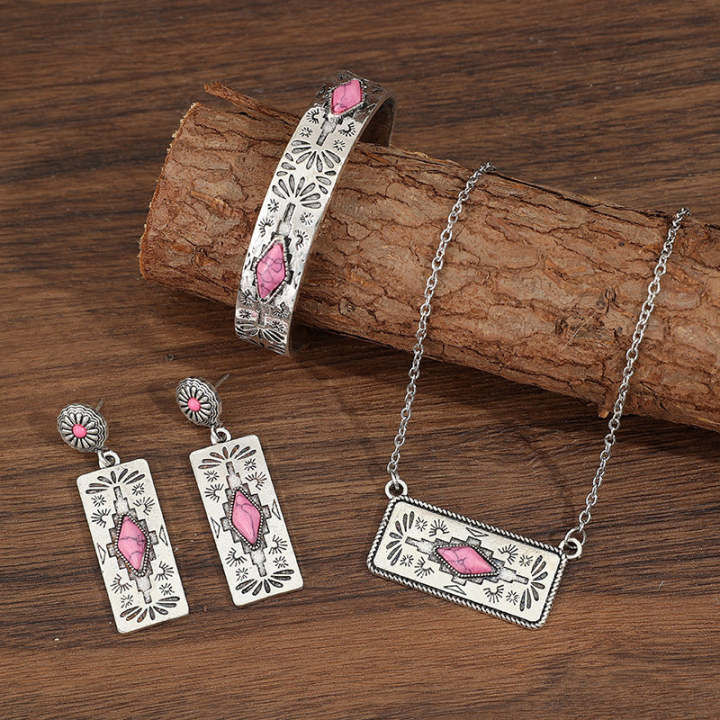
The geometric floral jewelry set page displayed $116.15 USD during review. Its visible option was labeled Three-Piece Suit. The page described turquoise, boho, vintage, geometric, and floral styling and positioned the set for casual, Western-inspired, occasion, and gift uses. It also advised shoppers to review the product images and selected option because colors can vary by screen.
A set name does not tell us which component should lead an outfit. The visible summary did not clearly provide a written inventory of all three pieces, numerical dimensions, weight, fastening details, complete components, surface treatment, construction method, or option-specific care. Verify those facts rather than inferring them from photographs.
Use the set as a menu, not an obligation. First photograph the white shirt and jeans with only the element intended to lead. Add the second component and compare. If the first focal point becomes less clear, remove the addition. A third piece should enter only when it supplies function or controlled rhythm instead of duplicate emphasis.
For a dressier version, refine shirt structure, denim condition, footwear, bag shape, and grooming before adding more jewelry. A coordinated set can still look modern and deliberate when its pieces have different visual jobs: one leads, one supports, and one remains unworn.
Browse Collections by Role, Not by Quantity
The Turquoise Jewelry collection is useful for comparing silhouettes, motifs, and jewelry zones. Before opening product pages, write the role you need: face-framing earrings, a neckline anchor, a quiet wrist detail, or a hand-level accent. This prevents browsing from turning into indiscriminate accumulation.
Keep a two-column note. In the first column, record only visible design observations. In the second, list facts that still require confirmation, such as dimensions, mass, closures, components, care, and option mapping. Never move an uncertain specification into the observation column merely because several images look similar.
Use One Quiet Echo Instead of a Matching Set
A quiet echo repeats one feature at lower intensity. Turquoise-colored jewelry might be echoed by a small cool-toned stitch, a muted bag detail, or a subtle denim cast. A geometric element might be echoed by a structured bag. A floral shape might be supported by a soft fabric curve rather than another obvious flower.
Limit the echo to one place. Repeating turquoise color in earrings, necklace, belt, bag, boots, nail color, and eye makeup usually weakens the focal point. The viewer begins counting matches instead of reading the outfit as a whole.
The published cowgirl jewelry style guide can help separate lead and supporting roles across earrings and necklaces.
Video Reference: What a 43-Second Styling Clip Can and Cannot Do
Wear It With Style: Turquoise Jewelry by JTV was available during review as a 43-second video. Its visible description presents turquoise as versatile enough for bold or subtle styling. Captions were unavailable.
Use the clip as a quick visual prompt: compare bold and quiet placement, then return to the exact product page. The video does not document the composition, origin, treatment, fastening, size, weight, durability, or care of the two Oroxen examples in this guide. It also cannot settle cultural or maker attribution. No transcript is reconstructed here; readers should view the original source and verify any material claim independently.
Run the Doorway, Conversation, and Detail Tests
The doorway test
Photograph the complete outfit from across a room. At this distance, the jewelry should register as the planned focal area without making the shirt and jeans look accidental. If footwear or a bag dominates, simplify the lower frame.
The conversation test
Frame the image from chest to head, approximating ordinary conversation distance. Check whether the focal jewelry has enough space and whether hair, collar points, glasses, or makeup compete. This is the most useful scale for earrings.
The detail test
Inspect fastening, contact points, seams, edges, and condition at close range. Styling success never overrides safety. If the selected item lacks the information needed for a confident test, pause and request it.
Create a Forty-Eight-Hour Outfit Trial
Do not judge the formula only in the final five minutes before leaving. Assemble it two days early. On the first day, complete a stationary review: daylight photographs, seated fit, collar contact, and visual hierarchy. On the second day, perform the movement route: stairs, reaching, bending, phone use, bag use, outerwear, car seat or seat belt, and safe storage.
Record failures as specific verbs: catches, taps, twists, hides, pulls, scratches, slides, or competes. A precise verb leads to a precise adjustment. “Feels wrong” often leads to random shopping. If the earring hides, change hair placement. If a necklace hits buttons, change only within its verified range or choose another piece. If the bag competes, simplify the bag.
Care for the Focal Point Without Guessing
A white shirt makes transfer, residue, and discoloration easy to notice. Put jewelry on after lotions, fragrance, cosmetics, and hair products have settled when that agrees with the documented care instructions. Check whether the piece touches collar edges, buttons, denim seams, rivets, zippers, or bag straps.
Do not assume a cleaning method from color or style wording. Avoid generic dips, toothpaste, vinegar, abrasives, heat, ultrasonic devices, or scratch tests on unidentified mixed materials. Store components separately in a clean protected space suitable for their verified construction. Photograph condition before cleaning, repair, or return.
For broader terminology before choosing care methods, consult the public introduction to Western jewelry styles and materials.
Common Ways the Focal Point Gets Lost
- Every accessory repeats turquoise color. Keep one quiet echo.
- Every motif is Western-themed. Let one documented design carry the theme.
- The shirt is treated as invisible. Count pockets, buttons, texture, and collar lines.
- All pieces in a set are worn automatically. Assign roles one component at a time.
- Hair placement is tested only while standing still. Turn, bend, use a phone, and add outerwear.
- Photographs are taken only at close range. Use doorway and conversation distances too.
- Style terms become material claims. Keep aesthetics and specifications separate.
- More jewelry is used to make the outfit dressier. Refine clothing finish and accessories first.
Frequently Asked Questions
Must boho turquoise jewelry be large to become the focal point?
No. Clear placement, contrast, negative space, and a quiet supporting outfit can make a smaller piece lead. Verify its real dimensions rather than estimating from photographs.
Can statement earrings and a necklace be worn together?
They can when fit, fastening, movement, symbolism, and visual hierarchy work together. Start with one leader, add the second piece, and compare photographs. Remove it if the focal area becomes unclear.
Do all three pieces in a jewelry set need to be worn?
No. A set provides options. Confirm what the selected set contains, then assign one component to lead and another to support only when the outfit benefits.
Which jeans are best with boho turquoise jewelry?
Choose jeans that fit the wearer, destination, weather, mobility needs, and desired attention hierarchy. Cleaner denim often makes face- or neckline-level jewelry easier to read, but there is no universal cut.
Does the word turquoise prove a natural gemstone?
No. Product naming and color appearance are not sufficient. Request option-specific composition and appropriate documentation when gemstone identity affects the purchase.
How can the look feel dressier without adding jewelry?
Refine the shirt's structure, tuck, cuff, denim condition, shoe finish, bag shape, and grooming. Keep the focal jewelry stable while changing one variable per photograph.
Final Focal-Point Checklist
- Name one lead jewelry zone before dressing.
- Allocate most of the attention budget to that zone.
- Use the white shirt as controlled negative space.
- Quiet denim hardware and distressing when they compete.
- Verify the selected product's mapping, dimensions, weight, fastening, components, construction, and care.
- Use only one low-intensity echo.
- Complete doorway, conversation, detail, and movement tests.
- Photograph each addition and remove anything that weakens the leader.
Explore the wider Western Jewelry collection or return to Oroxen for current product information. A successful focal-point outfit is not the one with the most matching pieces. It is the one in which every visible choice helps the viewer understand where to look first.