A black dress is often treated as a blank canvas, but no dress is truly blank. A matte T-shirt dress, ribbed knit column, satin slip, structured sheath, lace midi, and button-front denim dress each send a different message before jewelry is added. Moving faux turquoise jewelry from casual to dressy therefore requires more than adding a larger necklace or brighter shoes. The whole outfit must change in controlled increments.
This guide uses the term faux turquoise jewelry as a search and styling category for turquoise-colored or turquoise-style pieces whose natural-stone identity is not established here. It does not classify a specific Oroxen component without documentation. The two current examples are Western Turquoise Vintage Cross Jewelry for Women and Western Turquoise Vintage Earrings. Their names communicate a visual direction, not verified stone, metal, age, origin, maker, treatment, or cultural provenance.
Quick Answer: Use a Six-Control Dimmer Board
Imagine six sliders: garment structure, surface contrast, jewelry scale, accessory count, footwear formality, and grooming precision. A casual outfit usually keeps several sliders relaxed: softer dress construction, low-shine textures, practical shoes, and a single easy focal piece. A dressier outfit raises structure and finish while reducing accidental clutter.
Do not move every slider to maximum. Turquoise color against black already creates strong contrast. When the necklace or earrings are detailed, a polished dress, decorative bag, dramatic belt, and patterned boots can turn one intentional focal point into five unrelated announcements. Dressy means edited and context-ready, not simply more.
The public black-dress styling mistakes guide explains common hierarchy and fit problems. This article adds a step-by-step casual-to-dressy transformation system.
Define “Faux” Without Making Unsupported Claims
Faux may refer to imitation material, a turquoise-like color treatment, or fashion jewelry styled to resemble familiar turquoise aesthetics. Those meanings are not interchangeable. A photograph cannot establish which one applies, and a blue-green surface cannot establish natural turquoise. Use the exact product disclosure whenever it exists.
Before buying, request option-specific component materials, finish, setting or attachment method, measurements, weight, closure, care, and any stone or imitation description. Keep that information with the order. If composition remains unresolved, write and speak in visual terms: turquoise-colored center, blue-green detail, Western-inspired silhouette, or vintage-inspired appearance.
Responsible description improves styling decisions. Knowing that a surface is visually bright may guide color balance; knowing its actual component and finish guides cleaning, storage, skin-contact choices, and exposure. Never turn an aesthetic label into a material-care instruction.
Map the Black Dress Before Choosing Jewelry
Put on the exact dress and take front, side, seated, and walking photographs in the intended light. Record six garment facts: neckline shape, sleeve line, waist emphasis, fabric appearance, hem movement, and visible hardware. Then mark three jewelry zones: face, neckline, and waist.
| Dress feature | Casual direction | Dressier direction | Jewelry check |
|---|---|---|---|
| High crew neck | One pendant over a matte surface | Face-framing earrings, clean neckline | Verify total necklace drop or earring clearance |
| Open V or scoop | Short focal piece with simple shoes | Precisely placed pendant and structured layer | Keep pendant fully inside or outside the neckline |
| Shirt collar | Open collar with one relaxed accent | Defined collar and controlled earring outline | Prevent jewelry from crossing buttons |
| Satin-like surface | Limit shine elsewhere | Use deliberate finish repetition | Test friction and contact safely |
| Lace or embellishment | Choose a separated jewelry zone | Reduce scale and motif count | Avoid snagging and visual overlap |
The map prevents a category shortcut. “Black dress” does not reveal where a necklace will land, whether an earring catches, or how much detail is already present.
Use the Collection as a Silhouette Index
Browse the Turquoise Jewelry collection to sort pieces by outline rather than assumed composition. Group them into compact face-frame accents, long vertical necklaces, broad chest statements, rings, bracelets, and multi-component sets. Assign only one group to lead the black dress.
Next, build a two-row outfit sheet. Row one is casual: dress, focal jewelry, outer layer, bag, and shoes. Row two is dressy: the same dress and jewelry with altered structure, finish, and grooming. If changing the outfit requires replacing the entire wardrobe, the formula is not practical. A useful transformation preserves at least the dress, focal jewelry, and one supporting item.
Do not match every blue-green detail. Repetition can come from geometry, apparent finish, or spacing. One turquoise-colored focal point against black is often enough.
Example One: Western Turquoise Vintage Cross Jewelry
The current product page shows two choices under a selector labeled “Size”: 90cm and 52cm. Those values look like lengths, but the visible page does not clearly explain what each number measures, whether it includes the pendant, or which image belongs to each choice. Exact pendant dimensions, total weight, closure, component materials, finish, construction, and care are not visibly supplied.
The cross motif can create a strong center line on a black dress. It can also carry personal or religious meaning, so confirm that the wearer welcomes the symbol and that it suits the setting. Request a measurement diagram for both options, including chain or cord length, adjustment range, pendant height, pendant width, bail, and complete hanging drop.
Casual Formula: Daytime Column
Start with a matte or softly textured black dress, denim jacket or utility overshirt, and low-profile boots or clean sneakers. Let the cross occupy the center without a competing belt buckle. Use a practical bag whose strap does not cross the pendant zone.
Place a life-size paper outline at the verified drop. Walk, sit, bend, wear the jacket open and closed, and use the bag. If the cross reaches a zipper, button, or strap path, alter the verified length or choose a different formula. Do not accept repeated collision because the flat photograph looks balanced.
Dressier Formula: Framed Vertical
Use a structured blazer or clean shoulder line, a defined shoe, and a small bag kept away from the chest. Reduce other motifs and choose a neckline that gives the pendant an uninterrupted black field. Repeat one apparent finish in a small buckle or bag detail only after checking the full image.
Dressiness comes from controlled placement. The pendant should not hover uncertainly at the neckline edge or divide a decorative seam. Photograph it at table-seated height as well as standing height because social and dinner settings change the viewing angle.
Example Two: Western Turquoise Vintage Earrings
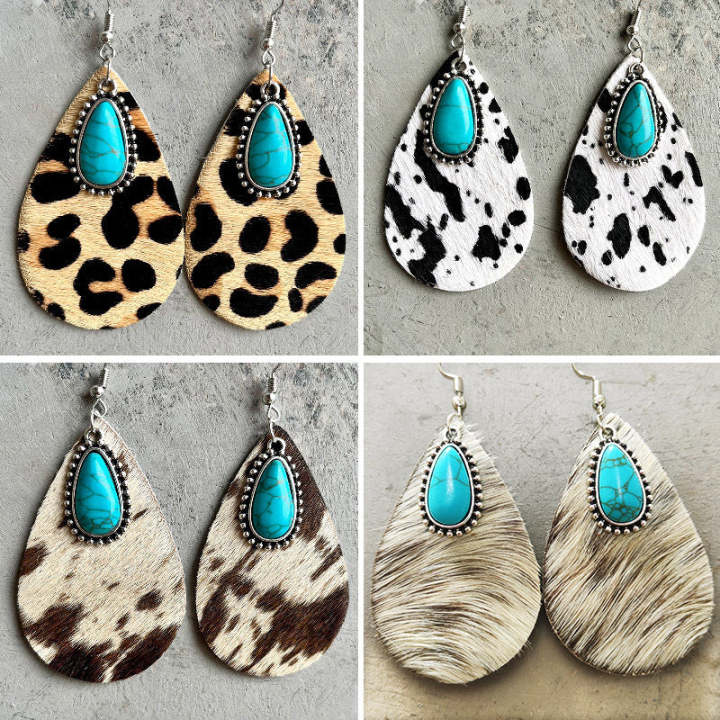
The current earring page displays Design 1 through Design 7 beneath a selector labeled “Size.” These are design names, not disclosed measurements. The visible page does not clearly provide option-specific height, width, total drop, profile, per-earring weight, closure, backing, component materials, finish, construction, or care. Ask which photographs correspond to every design before comparing them.
Earrings move the turquoise-colored contrast from chest to face. That is useful when a black dress has an ornate neckline, high collar, or surface that should remain uninterrupted. It also increases interaction with hair, glasses, hat brims, collars, headphones, and phone use.
Casual Formula: Face Accent and Open Layer
Pair a simple black dress with an open denim shirt, ankle boots, and one selected earring design. Skip the necklace so the open collar creates breathing room. Keep hair and hat choices clear of the earring path during the first wear test.
Dressier Formula: Clean Neckline and Precise Edges
Use a smooth neckline, structured jacket or wrap, refined shoe, and compact bag. Let the earrings provide the only blue-green area. A controlled lip, hair edge, or eyewear line can sharpen the portrait zone without adding another jewelry motif.
The public seven-way black-dress ring guide offers a useful companion principle: place a secondary accent in a different visual zone. If a ring is used, keep its motif and apparent scale quieter than the earrings.
A Five-Level Casual-to-Dressy Ladder
- Everyday relaxed: soft black dress, one focal piece, practical shoe, unstructured outer layer.
- Intentional casual: cleaner fit, repeated apparent finish, controlled bag strap, groomed accessory edges.
- Smart casual: structured layer, defined shoe, one focal turquoise-style area, reduced hardware.
- Dressy social: polished garment surface, precise placement, small bag, deliberate hair and makeup or grooming.
- Formal-leaning: only if the event dress code, jewelry facts, wearer comfort, and motif context support it.
Move one level at a time and take the same front, seated, and full-body photographs. The purpose is not to rank outfits morally. It is to identify which changes actually create polish and which merely add objects.
Run the Remove-One Test
Assemble the outfit, then remove one accessory before leaving. If the composition becomes clearer, the removed item was probably competing. Repeat until every remaining object has a role: focal point, frame, bridge, or utility.
A focal point leads. A frame directs attention toward it, such as a blazer lapel. A bridge repeats one color, shape, or apparent finish at a different scale. A utility item solves a real need. An accessory that does none of these may be decoration without function.
The remove-one test is especially useful with turquoise color on black because the contrast can make even a small element read strongly. Do not judge only in a mirror at arm's length; use photographs from the distances other people will see.
Video Walkthrough: Treat It as a Question Generator
The supplemental source is Turquoise Necklaces by John Hartman. Use it to observe how necklace silhouettes may occupy the chest, how multiple components change visual density, and which views would help a shopper ask better measurement questions.
The video does not document either Oroxen product. Watch it completely before using any idea, and independently verify every material, origin, treatment, maker, age, value, size, and care claim. Visual resemblance across different items is not authentication.
A productive viewing note is a question rather than a borrowed conclusion: How wide is the focal area? Where does the lower edge sit? Does the chain or cord adjust? What closure controls it? How does the piece move when the wearer turns? Direct those questions to the exact seller and option.
Black-Dress Styling Mistakes and Better Alternatives
Putting the Pendant on a Neckline Border
A focal shape cut in half by a V, scoop, or jacket edge appears accidental. Move it fully inside the skin opening or fully onto the dress after confirming length.
Combining Several Western Motifs at the Same Scale
Cross, cow skull, cactus, horseshoe, floral engraving, and oversized buckle can compete when equally prominent. Select one leader and turn other references into smaller echoes.
Using Shine as the Only Dressy Signal
Strong shine can emphasize clutter. Add structure, clean edges, appropriate footwear, and precise placement before increasing reflective surfaces.
Assuming Black Makes Everything Compatible
Black increases contrast but does not solve length, fit, movement, snagging, motif context, or care. The garment map still controls the decision.
Treating “Vintage” as Age
Vintage-inspired describes appearance unless actual age is documented. Avoid historical claims based on a title or distressed-looking finish.
Frequently Asked Questions About Faux Turquoise Jewelry
Can faux turquoise jewelry look dressy?
Yes. Dressiness depends on the complete outfit, precise placement, surface relationships, event context, and condition. Do not use perceived material prestige as the only styling measure.
Which works better with a high-neck black dress: necklace or earrings?
Earrings keep the neckline clear, while a sufficiently long verified necklace may create a strong vertical line over the dress. Compare real dimensions, contact, and the garment surface.
Can I wear both the cross jewelry and statement earrings?
Possibly, after verifying each piece and testing the combined outline. Let one lead, separate their visual zones, and remove either item if they compete or make physical contact.
What outer layer makes the outfit more casual?
An open denim or utility-inspired layer often relaxes the presentation, but fabric, construction, fit, and hardware matter. Check collar and strap contact with the jewelry.
How can a black dress feel more Western without becoming costume-like?
Use one recognizable Western-inspired element, repeat a restrained color or apparent finish, and keep the rest grounded in normal wardrobe pieces. The public Southwestern turquoise-style black-dress guide provides additional motif and proportion checks.
How should the jewelry be cleaned?
Follow option-specific seller care instructions based on documented components and finish. Do not apply a natural-turquoise or metal-cleaning method to an unidentified fashion component.
Final Styling Worksheet
- Name the exact dress and photograph its neckline, surface, seams, and hardware.
- Describe the turquoise-style jewelry only with supported facts.
- Obtain option mapping, dimensions, weight, closure, components, finish, and care.
- Assign one focal zone: face, neckline, or waist.
- Set the six dimmer sliders for the intended level of dressiness.
- Test standing, seated, walking, outer-layer, bag, and phone states.
- Run the remove-one test and save the successful formula.
Explore current options in Western Jewelry and return to Oroxen for current store, option, and product information. The most convincing casual-to-dressy transformation keeps the black dress and focal jewelry recognizable while changing structure, spacing, and context with discipline.